
OptiStudio

Run your plant smarterevery shift, with decisions operators trust.

Continuously optimize setpoints, align SOPs with real operations, and deliver explainable decisions your teams can execute safely.

5–15%
Energy cost reduction
3–8%
CO₂ intensity reduction
6–18 mo
Payback period
70–80%
Faster SOP authoring

Running a plant is complex. Optimizing it is even harder.

Energy-intensive plants run hundreds of interdependent variables where small changes create non-linear impact on energy, quality, and equipment health.

Complexity

Hundreds of interdependent variables

Plants run on variables that interact in non-linear ways. Changing one setpoint ripples through energy use, product quality, and equipment health in ways that spreadsheets and manual analysis cannot track.
Outdated SOPs

Procedures that lag behind operations

Standard operating procedures drift from actual plant behavior over time. Engineers do not have the bandwidth to audit and update them continuously, leaving operators without reliable guidance.

Reactive tools

Tools that show the past, not the path

Most industrial software shows what happened. OptiStudio shows what to do next continuously surfacing optimized recommendations operators can act on in real time.

AI in silos

Pilots that never reach the operator

AI proof-of-concepts succeed in the lab but fail to reach the plant floor. Without operationalization, insights stay locked in models and dashboards, never influencing the shift.

Platform execution

Two governed workflows.
One operating standard.

ML Optimizer and SOP Generator keep setpoint intelligence and procedure governance in sync from model to shift floor.

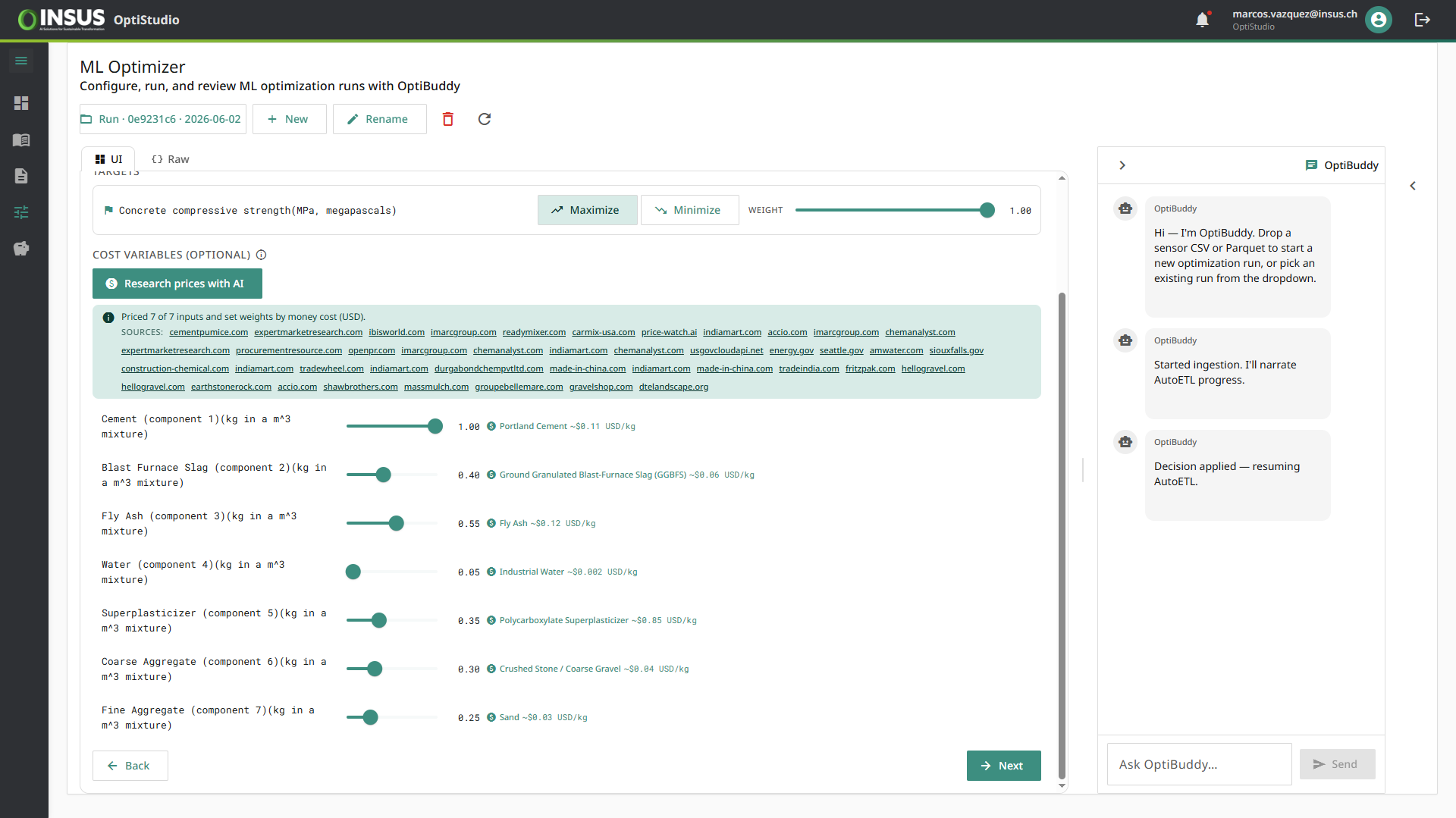
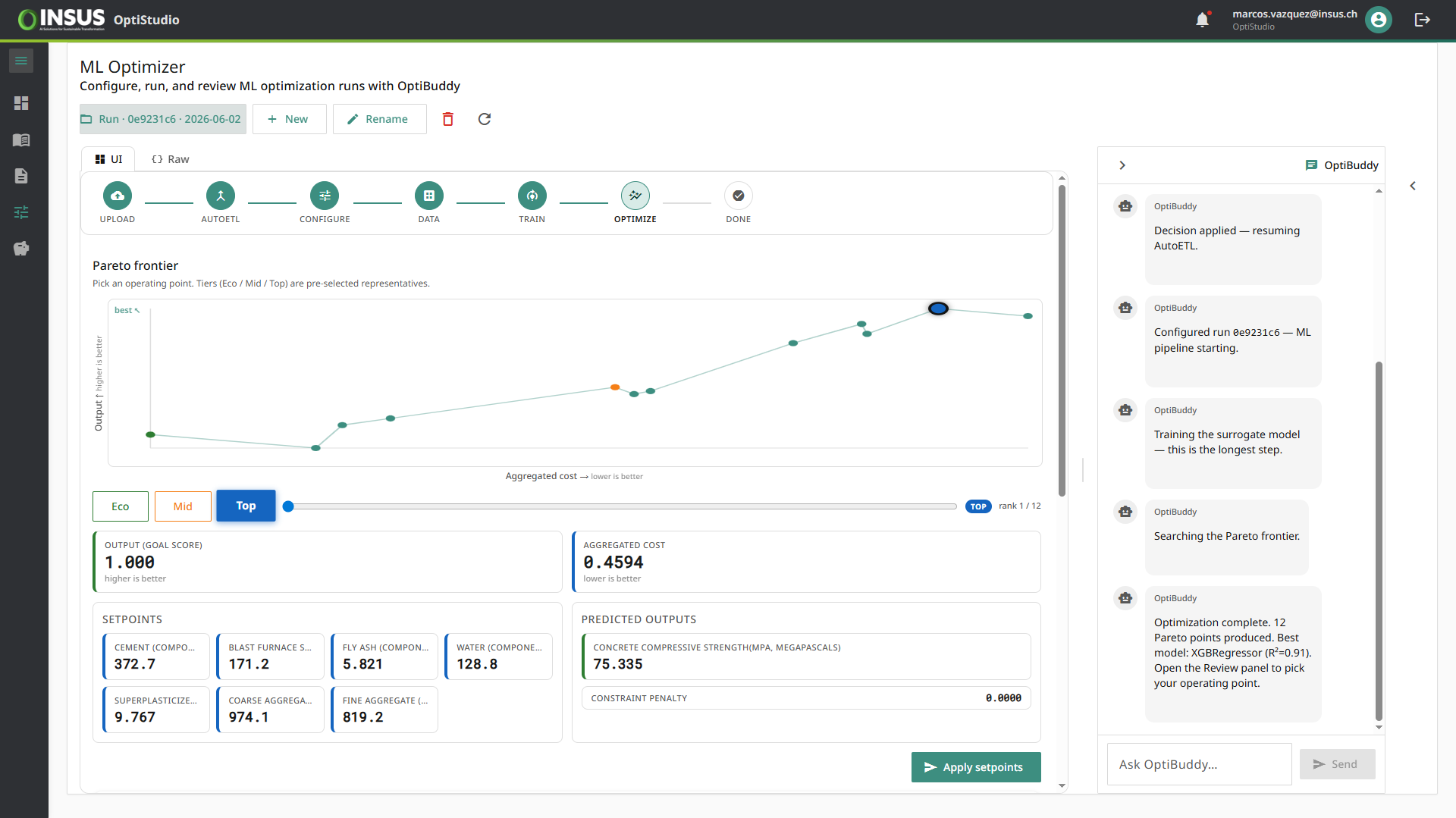
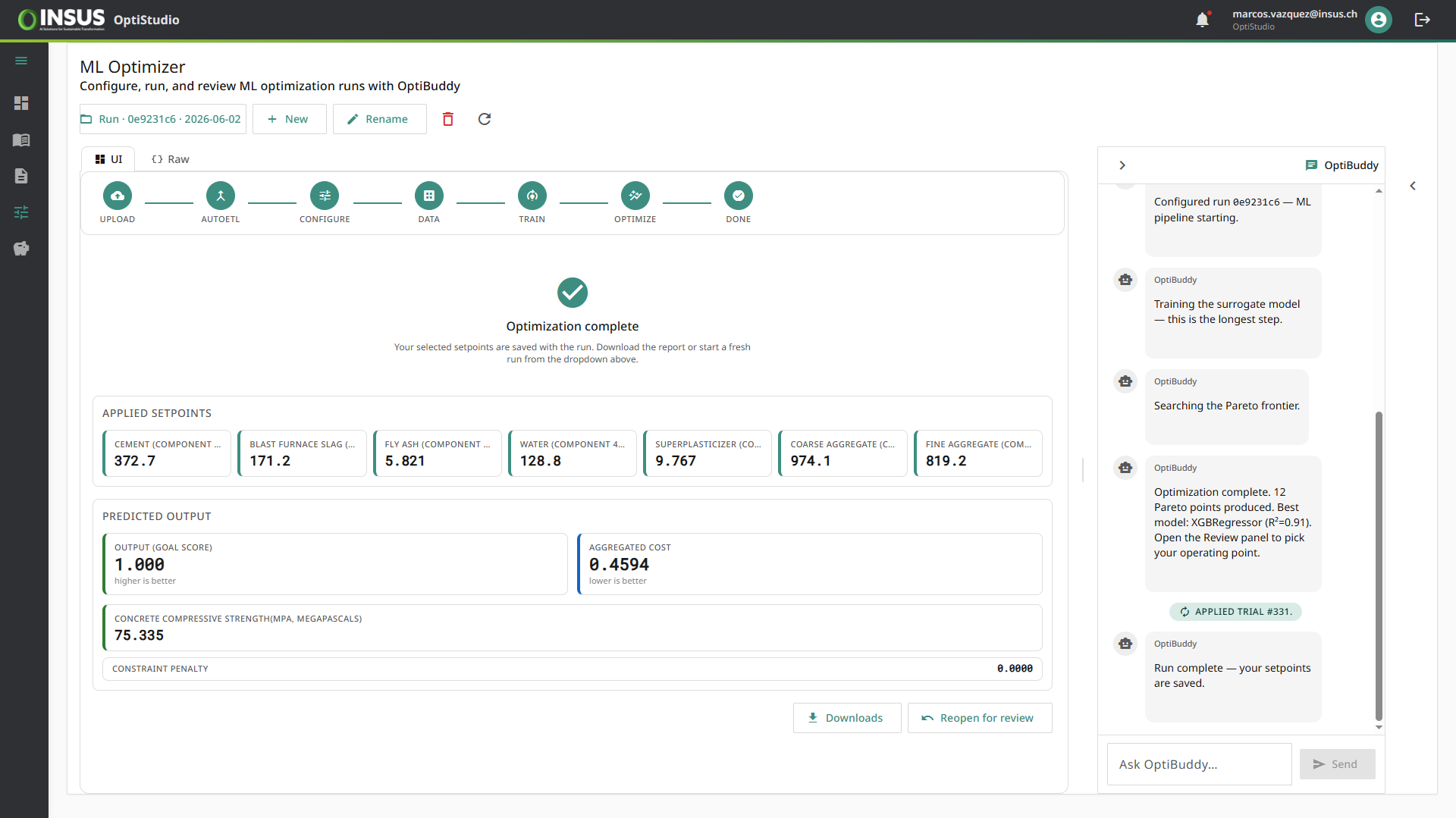
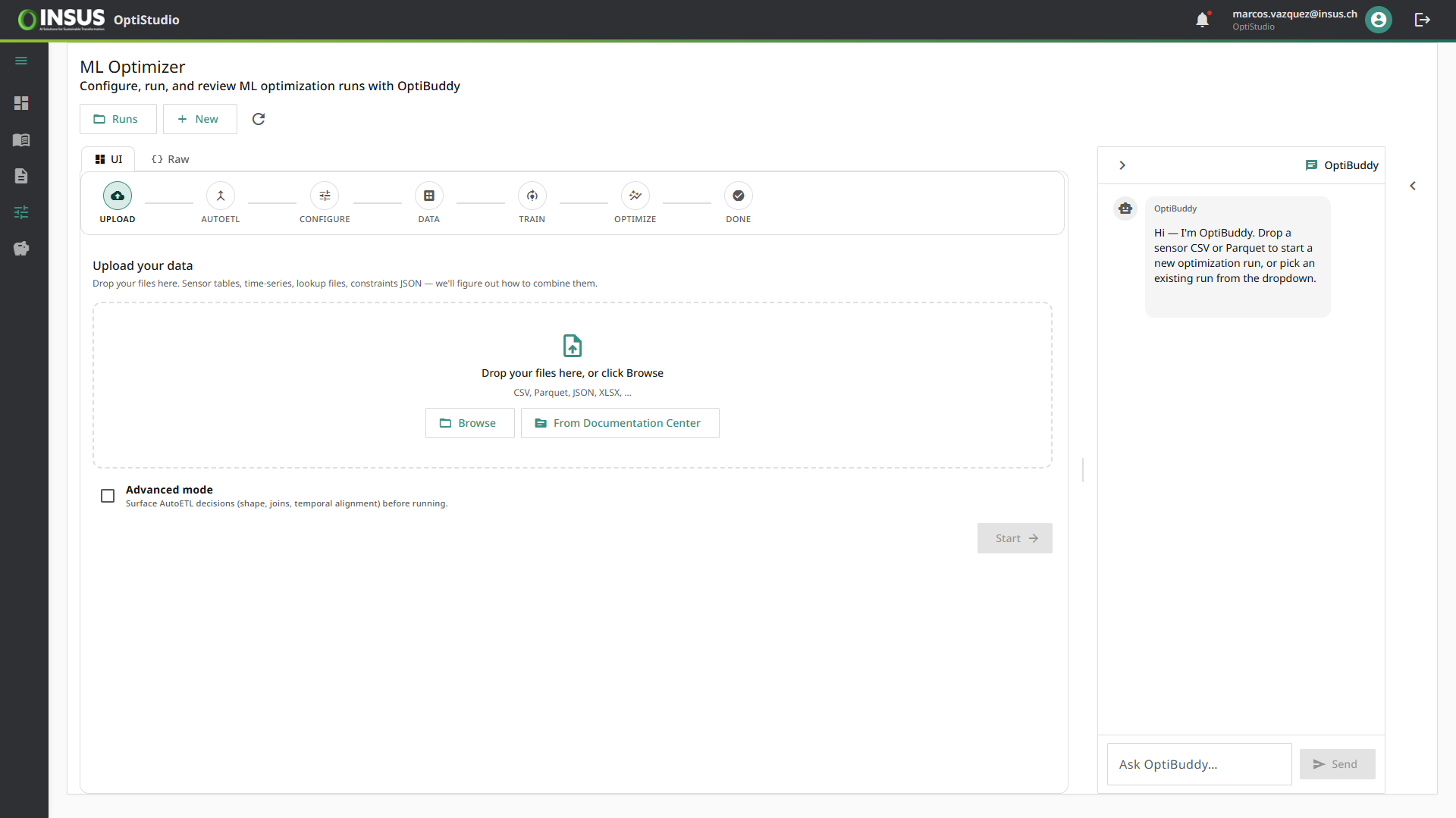
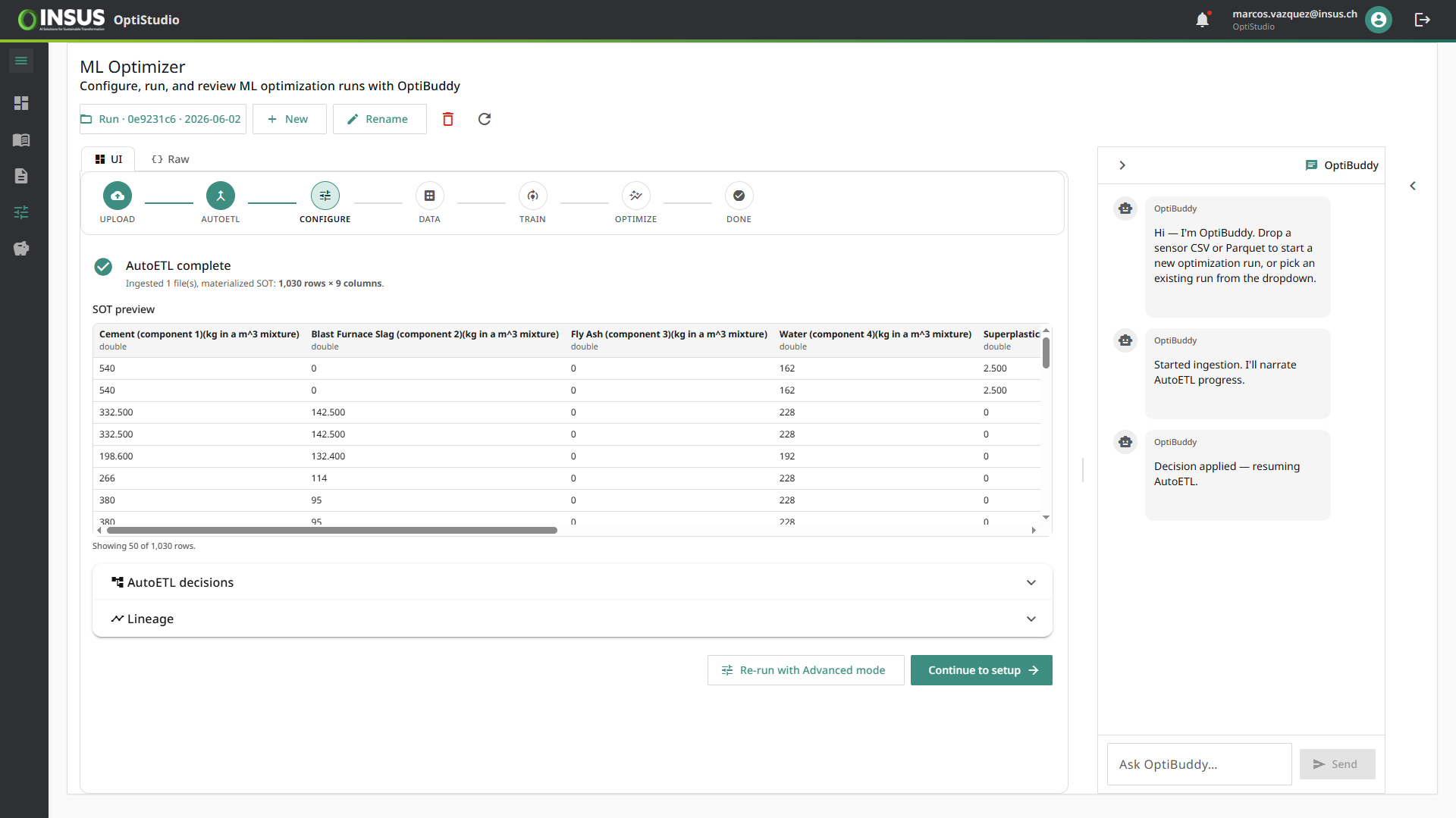
OptiStudio ML Optimizer upload screen

ML OptimizerData Foundation

Built to optimize operations at plant scale

OptiStudio combines governed data, optimization intelligence, and SOP execution workflows into one production-ready operating layer.

Unified industrial data layer

Ingest and harmonize historian, lab, and operational data from any source into a clean, structured foundation for AI.

Hybrid process and AI modeling

Combine first-principles process knowledge with machine learning to build models that are accurate, interpretable, and robust.

Multi-objective optimization engine

Simultaneously optimize energy, quality, throughput, and emissions under real plant constraints not one variable at a time.

SOP lifecycle workspace

Audit existing procedures, detect gaps from optimized operations, and generate structured SOP drafts engineers can review and approve.

Scenario and what-if studio

Test operating strategies virtually before deploying them. Compare scenarios side-by-side with full transparency into trade-offs.

Operator-ready recommendations

Surface optimized setpoints and guidance in operator interfaces explainable, traceable, and safe to act on every shift.

Closed-loop control integration

Connect recommendations to DCS and control systems for automated or semi-automated deployment of optimized setpoints.

Governance access and auditability

Role-based access control, full audit logs, and traceability to meet industrial compliance and safety requirements.

Proven in industrial environments

5–15% energy reduction per ton, 3–10% OEE improvement, 3–8% CO₂ intensity reduction, and 6–18 month payback on targeted deployments.

5–15%

Energy reduction per ton

3–10% OEE improvement and 3–8% CO₂ intensity reduction on comparable energy-intensive lines.

Real project Rigid foam insulation

Constrained optimization across 44 variables and ~26,000 records reduced core density from ~1.656 to 1.628 g/cm³ while maintaining high quality pass rates.

Minimize core density across 7 plants while preserving quality

Generated optimization insights were translated into updated SOP guidance for formulation settings and operating windows at each site.

6–18 mo

Payback period

Multi-site rigid foam insulation deployment with governed optimization and SOP alignment across seven plants.

Use cases

Continuous optimization for plants under real-world constraintsnot templates.

Multi-objective optimization across cement, steel, chemicals, and utilities trained on your plant's constraints, not generic APC templates.

Cement plant operations
5–12% Heat reduction
Cement & Clinker

Optimize kiln, mill, and fuel-mix decisions

Optimize kiln fuel consumption, clinker quality, and throughput simultaneously. Reduce specific heat consumption while maintaining product specifications across varying raw material inputs.

Steel and metals operations
6–15% Energy savings
Steel & Metals

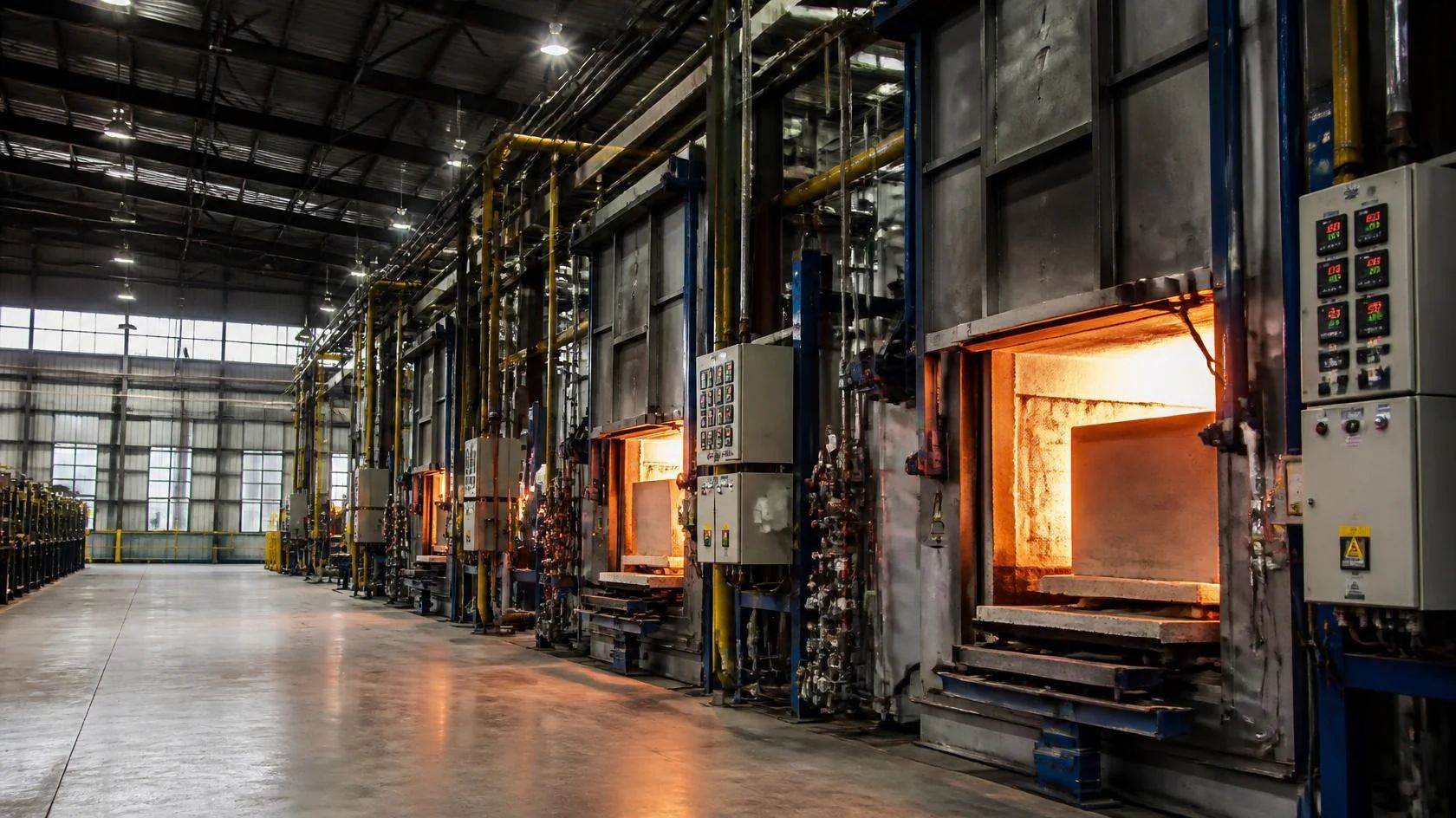
Optimize furnace and rolling operations

Balance furnace temperature profiles, energy input, and product metallurgy across complex interdependencies. Reduce reheating costs and improve yield while meeting tight dimensional tolerances.

Chemical plant operations
4–10% Yield improvement
Chemicals

Balance yield, utilities, and safety limits

Optimize reactors, distillation, utilities, and changeover procedures with governed setpoints that maintain safety envelopes, quality targets, and compliance.

Manufacturing operations
3–10% OEE improvement
Manufacturing

Stabilize lines with schedule-aware SOPs

Reduce cycle times, minimize material waste, and improve first-pass quality across production lines. Optimize machine setpoints and scheduling for maximum OEE.

Energy-intensive operations
5–15% Energy cost reduction
Energy-Intensive

Optimize high-energy production assets

Minimize energy cost across assets with variable load profiles. Align consumption with energy pricing signals and optimize across multiple energy vectors simultaneously.

Utilities operations
4–10% Fuel savings
Utilities

Coordinate utilities with tariff awareness

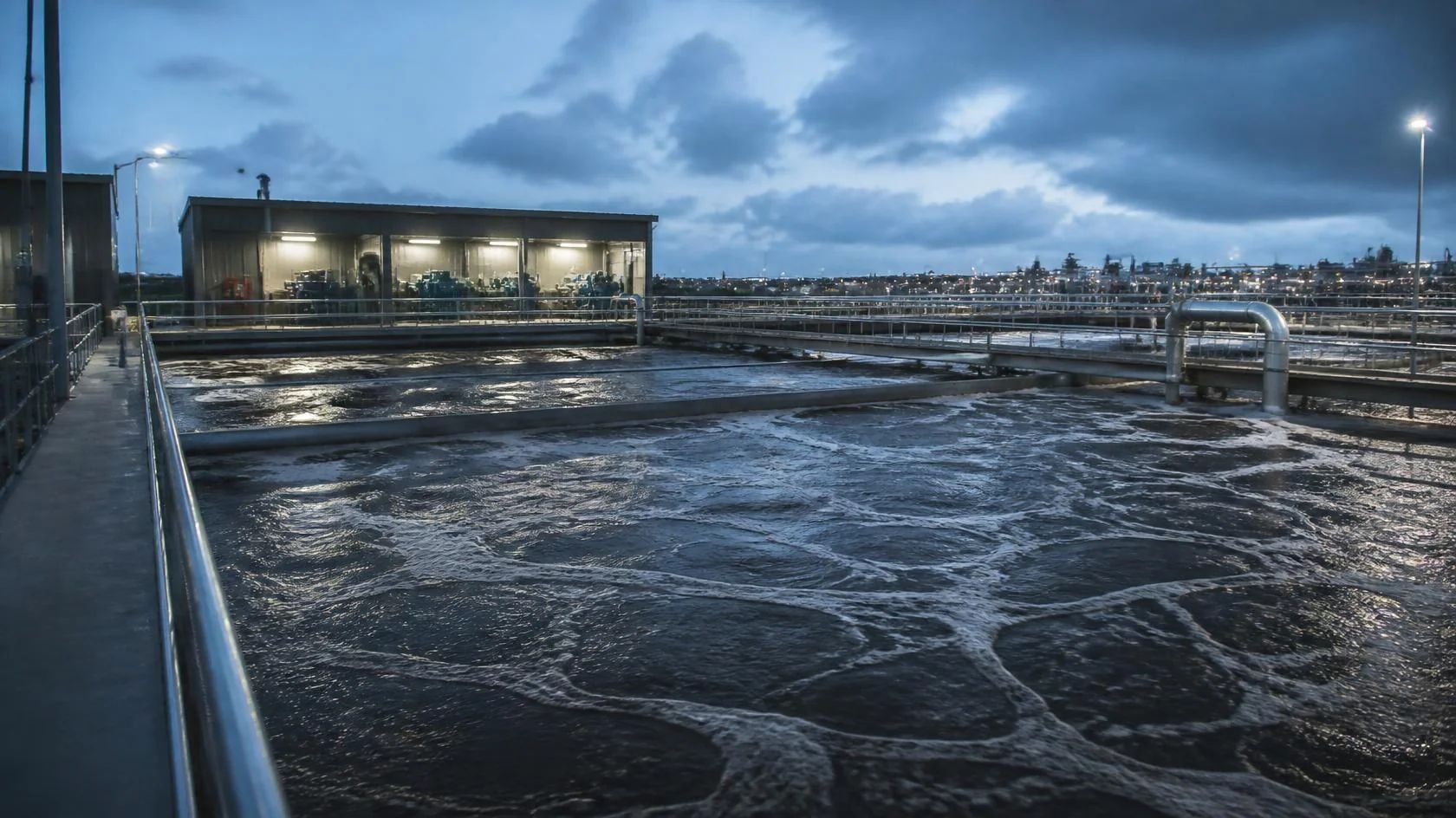
Optimize generation dispatch, load balancing, and asset utilization across distributed infrastructure. Reduce fuel costs while meeting reliability and compliance requirements.

Connected plant intelligence

OptiStudio connects plant data, procedures, and business systems into one optimization-ready layer.

Talk to an expert

How the capabilities stack up

Optimization scope

OptiStudio

Multi-objective: energy, quality, throughput, emissions

Traditional APC / EMS

Single-variable or single-objective

SOP management

OptiStudio

Built-in SOP audit, gap detection, and draft generation

Traditional APC / EMS

Not included

Model type

OptiStudio

Hybrid: process physics + AI

Traditional APC / EMS

Statistical or rule-based

Operator interface

OptiStudio

Integrated recommendations surfaced in operator workflows

Traditional APC / EMS

Separate system or dashboard

Scenario testing

OptiStudio

Built-in what-if and scenario studio

Traditional APC / EMS

Limited or manual

Closed-loop capability

OptiStudio

Native DCS/control system integration

Traditional APC / EMS

Requires custom integration

Frequently asked questions

Traditional APC focuses on single-variable control loops. OptiStudio runs multi-objective optimization simultaneously across energy, quality, throughput, and emissions while also managing the SOP lifecycle and surfacing explainable recommendations operators can act on.

Yes. The SOP Alignment module audits current procedures against optimized plant behavior, detects gaps, and generates structured SOP drafts. Engineers review and approve OptiStudio surfaces the work, your team owns the outcome.

OptiStudio ingests data from historians (OSIsoft PI, AspenTech, etc.), lab systems, and operational databases. A focused rollout typically starts with 12–24 months of historical data and expands from there.

Yes. OptiStudio is built for multi-site, multi-line deployment. Models can be shared, adapted, and governed across sites while maintaining local operational context.

OptiStudio operates in read-first mode by default, with recommendations surfaced to operators before any control action. Closed-loop integration includes safety constraints and operator override at every step. Role-based access and audit logging meet industrial compliance standards.

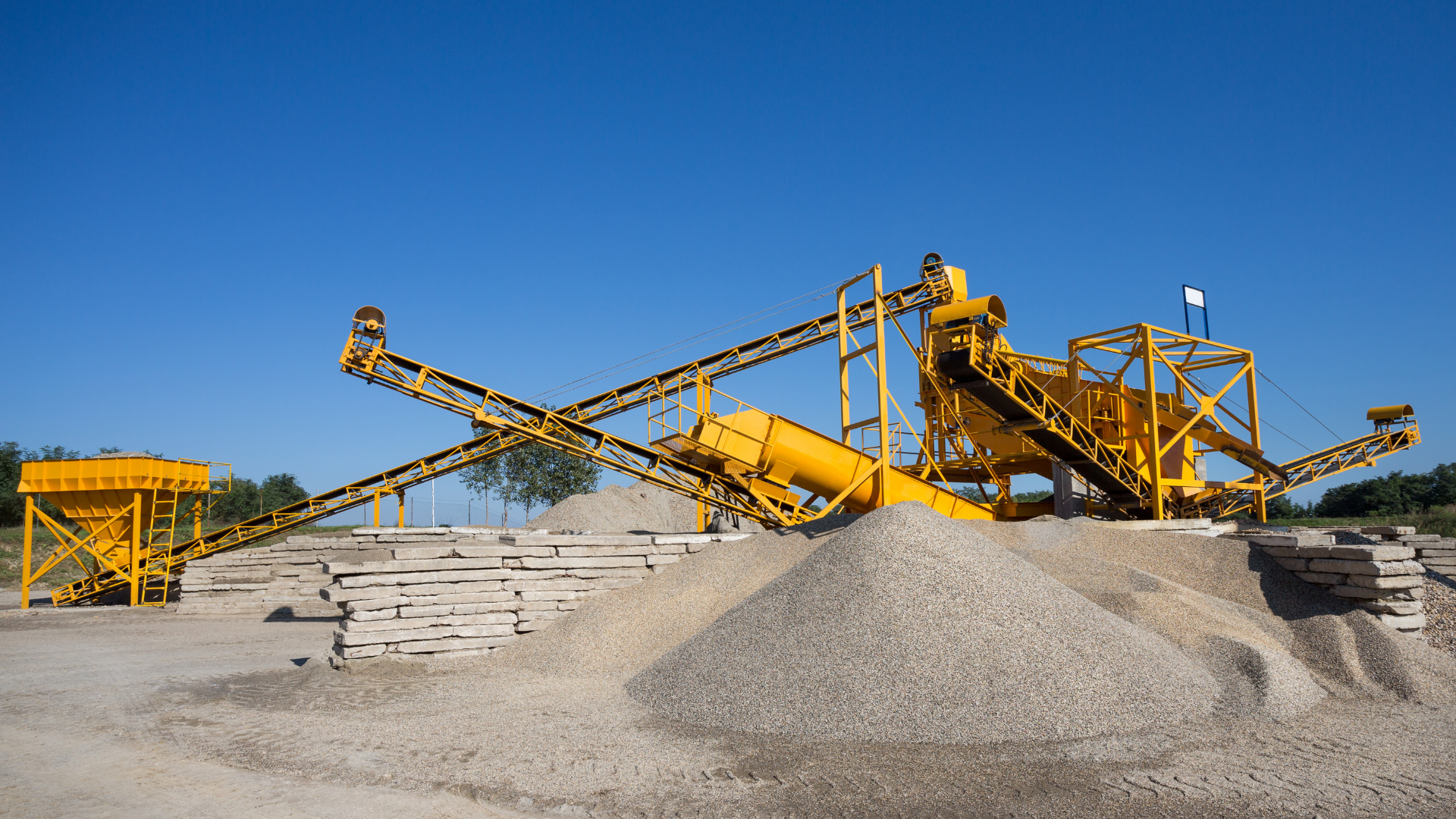
Industrial operator reviewing plant optimization and SOP workflows

Ready to reduce energy cost, cut CO₂, and keep SOPs current?

Start with one line or utility system, demonstrate value, and scale with repeatable optimization and SOP governance workflows.