Today
Mill behaviour is managed after it changes
- Load and power draw move with feed and ore conditions.
- Fresh feed is adjusted once the mill has already shifted.
- Specific energy drifts without a stability-oriented view.

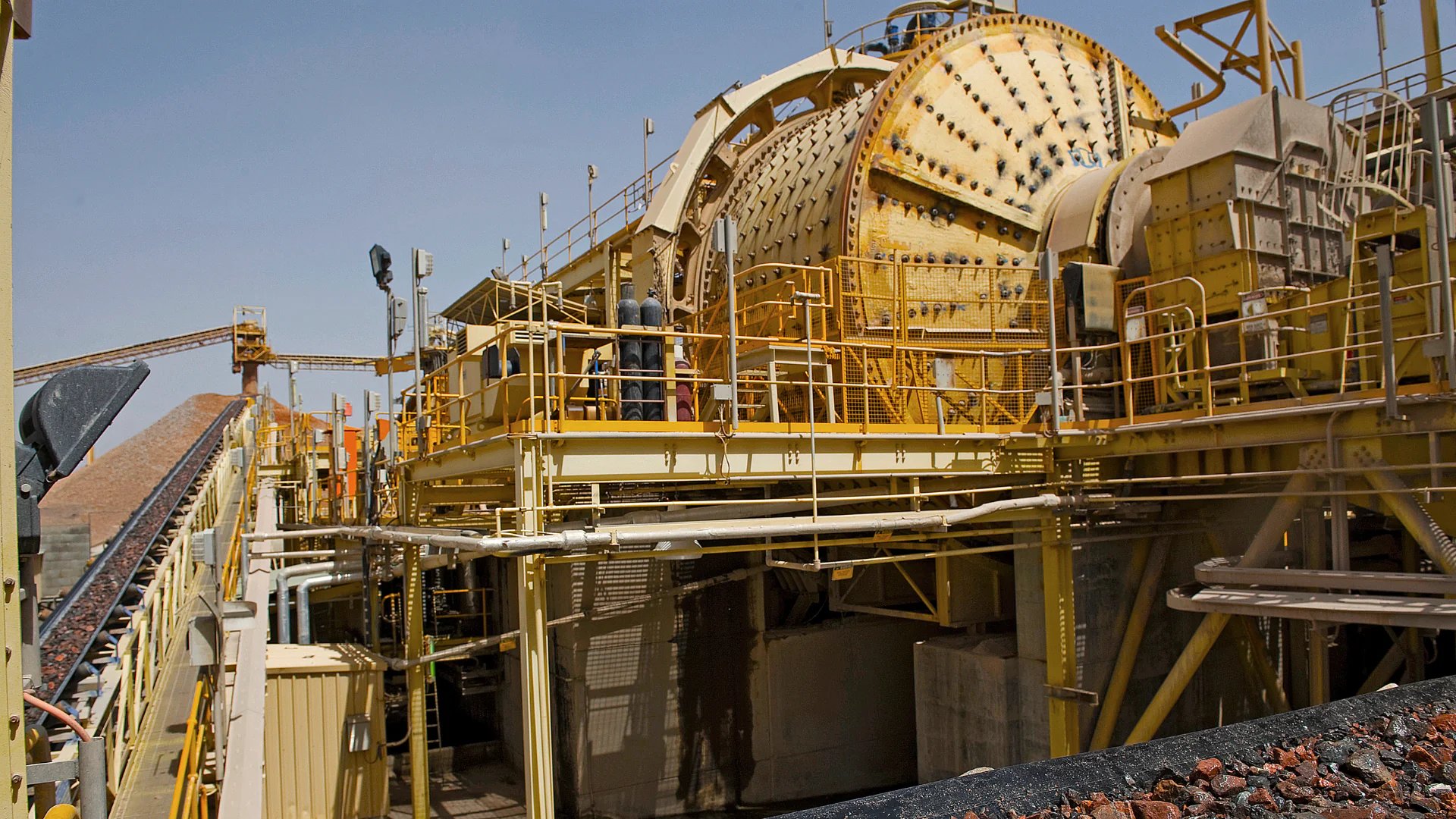
Comminution is one of the largest energy consumers in mineral processing. INSUS uses existing mill instrumentation and the circuit's own operating history to anticipate circulating-load disturbances, stabilise mill load and power draw, and work toward a lower specific-energy baseline. Operators and the existing DCS stay in control.
01
Built on mill load, power draw and feed tags you already log.
02
Advisory first. The existing DCS stays on the loop.
03
Measured in kWh per tonne against your own baseline.
The problem
Grinding reduces ore to a size the downstream circuit can separate, but SAG and AG circuits run under continuously changing ore and load conditions. Shifts in fresh feed and circulating load pull mill load and power draw away from the intended operating point, and the operator often reacts once the disturbance has already arrived.
The shift
Process and control teams stay responsible for every change. What changes is whether circulating-load disturbances are anticipated early enough to hold load and power nearer the operating target.
Today
With INSUS
How it works
This fits OptiStudio as process and energy decision support beside the existing grinding control architecture. Day one is advisory. The existing DCS stays on the loop.
Connect
Pull mill load, power draw, fresh feed rate, circulating load and related process variables from existing SCADA, DCS and historian systems. No new mill hardware or sensors are required.
Understand
Analyse the historical relationship between fresh feed, circulating load, mill load and power draw for your own equipment and ore, so the model reflects this plant rather than a generic circuit.
Predict
Identify changes likely to move mill behaviour and give forward visibility of circulating-load disturbances before they drive significant load or power-draw variation.
Advise
Recommend fresh feed rate and related control-loop parameters aimed at holding mill load steady while moving specific energy down. Recommendations sit alongside existing control practice for operator review.
Verify
Track specific energy, throughput, mill-load variability and power-draw variability against the circuit's pre-implementation baseline, and refine the model against how the plant actually runs.

Getting started
For minerals plants that already instrument SAG or AG circuits. Delivered through OptiStudio as grinding energy and stability decision support. Expert Services can help with data assessment and validation. Day one is advisory beside the existing DCS. No new mill hardware.
Related for minerals
Grinding sits beside flotation recovery and Strategic Project documentation on the same minerals operation.
SAG and AG circuits lose stability and energy efficiency when circulating-load disturbances arrive before the operator can respond. This use case anticipates those disturbances and recommends feed and control responses for review.
Mill load, power draw, fresh feed rate, circulating load and historical specific energy, plus available ore characteristic and production-target context. No new sensors.
No. The existing control infrastructure stays in place. Recommendations start advisory, alongside current control practice.
Only as a later question, after recommendations are validated against actual circuit performance. Any production control deployment should keep operator override and existing plant safeguards.
Against the circuit's own baseline, using specific energy consumption, throughput, mill-load variability and power-draw variability. External trial figures are not treated as promised results for your plant.
Through OptiStudio as process and energy decision support for the grinding circuit. Expert Services can support data assessment, integration and validation with your process and control teams.
The approach depends on reliable instrumentation and enough operating history. Results are specific to that circuit, its configuration and its ore, so everything is validated against the plant's own baseline.
Comminution optimization
Establish where energy and variability are actually being lost, then test whether anticipating circulating-load disturbances moves the circuit toward a steadier, lower-energy baseline.