Today
Heat covers uncertainty
- Operators watch kiln temperatures, fuel, feed, O₂/CO and draught.
- Free lime arrives after that clinker has already moved.
- When meal or fuel drifts, a higher temperature setpoint is often the safe response.

INSUS reads kiln, fuel, gas and free-lime data the plant already logs, and recommends a feasible burning-zone temperature window for panel review. Operators and process engineers decide. Existing DCS and APC stay in charge.
01
Free lime often lands after the cooler.
02
Extra heat becomes the safe default.
03
Advisory only. Recommendations stay under plant control.
The problem
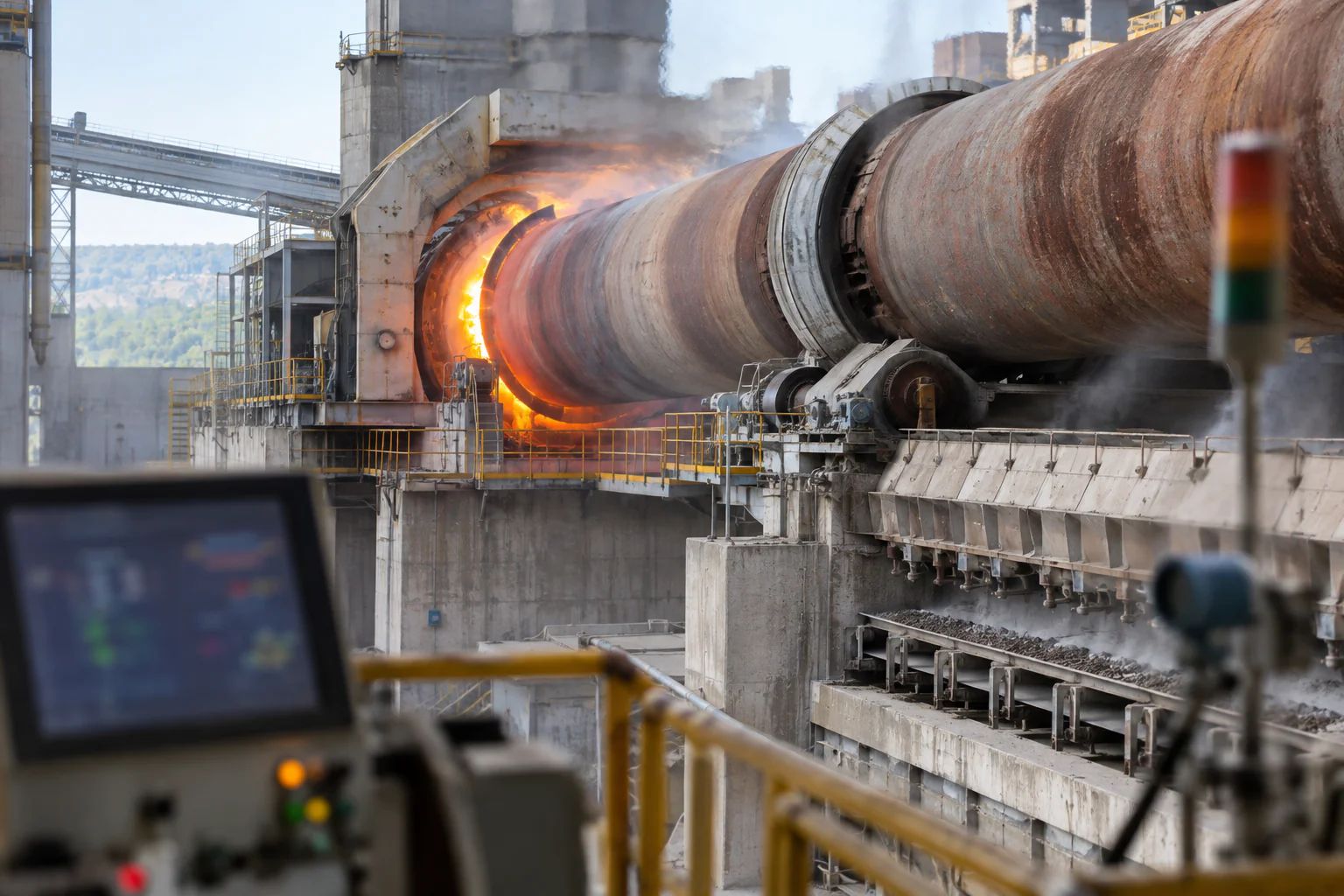
Burning-zone temperature, secondary air, draught, fuel rate and raw-meal chemistry interact continuously. Free lime confirms whether that zone was hot enough, but the sample is usually taken after the clinker has left the cooler. Between tickets, operators protect the quality band with a temperature margin. That margin costs fuel, can raise emissions exposure and adds thermal stress on the kiln lining.
The shift
The CRO, process engineer and kiln DCS stay in charge. What changes is whether temperature advice arrives while the panel can still act, based on how this kiln relates heat to free lime.
Today
With INSUS
How it works
This fits OptiStudio as kiln decision support above the DCS and historian. Access is read-only on day one. It does not write setpoints or override APC.
Connect
Connect read-only to DCS and historian tags for kiln and burning-zone temperatures, fuel rates, feed, draught, O₂/CO and related gas conditions, LIMS free-lime and clinker quality results, and raw-meal or fuel property records where available.
Understand
Learn how temperature profile, fuel mix and meal conditions have related to free lime, specific heat consumption and process stability on this kiln, not from a generic cement template.
Predict
Given current kiln conditions, predict likely free-lime and thermal performance ranges so the control room can see when the plant is running hotter than this meal and fuel require.
Advise
Advise temperature and related adjustments inside agreed quality, emissions and equipment constraints. Operators and process engineers approve what reaches the panel. Existing DCS and APC stay in charge of the loop.
Verify
Compare recommended conditions with actual free-lime results, specific heat and kiln stability. Confirmed and rejected recommendations refine the plant-specific model.

Getting started
For cement kilns where free lime arrives after the cooler and temperature margin covers the gap. Delivered through OptiStudio as kiln decision support. Expert Services can help with data assessment and validation. Advisory and read-only. Models are built for the individual kiln.
Related for cement
Clinker temperature optimization sits beside cement quality prediction and kiln fuel and feed optimization on the same plant.
Free lime often arrives after the cooler, so burning-zone temperature is held with a safety margin. This use case recommends a feasible temperature window from plant data for CRO or process engineer review.
Kiln and burning-zone temperatures, fuel and feed rates, draught and O₂/CO or equivalent gas tags from DCS and the historian, free-lime and related LIMS results aligned to production periods, and raw-meal or fuel property records where available.
No. Day-one delivery is advisory. Recommendations go to the CRO or process engineer. Existing DCS, PLCs and any APC stay in charge of the loop. Safety interlocks are not touched.
This page focuses on the burning-zone temperature window relative to free lime and thermal energy. Fuel-and-feed optimization focuses on fuel rate, air and feed setpoints when those are the primary levers. They are sibling use cases on the same kiln, not duplicates.
Through OptiStudio as kiln decision support. Expert Services can support data assessment, integration and validation with your process team.
No. Thermal energy, free lime and kiln stability depend on meal chemistry, fuel mix, equipment condition and operating practice. Value is judged against agreed baselines on the pilot kiln.
Models are kiln-specific and do not transfer unchanged. Missing or unreliable temperature or gas tags are a data prerequisite. Closed-loop setpoint writing is out of scope for day one.
Cement · Kiln · Burning zone
A back-test on one kiln and the free-lime history you already keep will show when temperature is protecting quality, and when it is only protecting habit.