Gypsum industry

Where the dryerpays for the slurry

Gypsum is calcined into stucco. Water keeps the slurry pourable — then most of that water has to be dried out of the board. Moisture and strength are confirmed after the line has already moved. The plant still has to ship.

  • 01

    Heat spent on this calciner, not the last campaign

    Read kiln and calciner tags the plant already logs, so extra fuel is not the only answer when feed moisture or stucco demand changes.

  • 02

    Dryer load that matches this slurry

    Hold water-to-stucco, forming, and dryer readings against the board record you already keep — not after the warehouse finds soft or warped board.

  • 03

    The stop while the line can still be planned

    Read dryer fans, conveyors, mixers, and kiln signals already in the historian, so wear is flagged while intervention can still be scheduled.

On the calciner and the dryer

Quality is decided before the board cools

Gypsum plants lose money in three places that rarely share one screen: a calciner burning more than the stucco needs, a slurry carrying more water than the reaction requires, and a board moisture or strength miss found after the dryer. Most of that is already in historian tags, lab tickets, and line records — after the fact.

Industrial calcination and combustion systems under continuous loadThe calciner

Stucco quality sets what the slurry can do

Gypsum is converted to stucco (calcium sulfate hemihydrate) by calcination — often gas-fired. Poor particle quality in high-throughput calcination can force more water into the slurry for processability, pushing dryer energy up later on the line.
Industrial mixing, water, and utility systems on a continuous process lineThe slurry

Excess water is processable — and expensive to dry

Only about 20 wt.% water is needed for the stucco-to-gypsum reaction, yet significant excess water is often added so the slurry can be poured and formed. That leftover water becomes dryer load and fuel cost.

Plant team reviewing dryer and board quality readingsThe dryer

Most plant energy is spent removing water you already added

U.S. Department of Energy–funded research on gypsum wallboard drying reports that producing one ton of board can require about 445 kWh of drying energy — roughly two-thirds of overall manufacturing energy in that analysis. The board still has to meet moisture and strength specs.

Turning the dryer up is the easy correction. It is also how the campaign is spent.

INSUS works from calciner tags, slurry and dryer records, lab tickets, and equipment logs a plant already keeps. If the gap is feed moisture, a drifting dryer zone, or a soft board that already shipped, that is what we will say. Recommendations stay advisory. Existing control systems stay on the loop.

Explore the possibilities

Industry figures

The scale of what is being decided

Four external figures, each with its source. Nothing on this page is an estimate we made up. Where we cannot cite a number, we describe the situation in words instead.

Drying

~2/3

of overall gypsum wallboard manufacturing energy is associated with drying in DOE-funded analysis, with about 445 kWh of drying energy cited per ton of board in that work.

Source: DOE / OSTI gypsum drying energy report

Scrap

~700kt/yr

of gypsum scrap generated by wallboard manufacturing is recycled onsite in the United States, according to USGS — a plant-level stream that still has to be managed against board quality and feed.

Source: USGS Mineral Commodity Summaries 2025, Gypsum

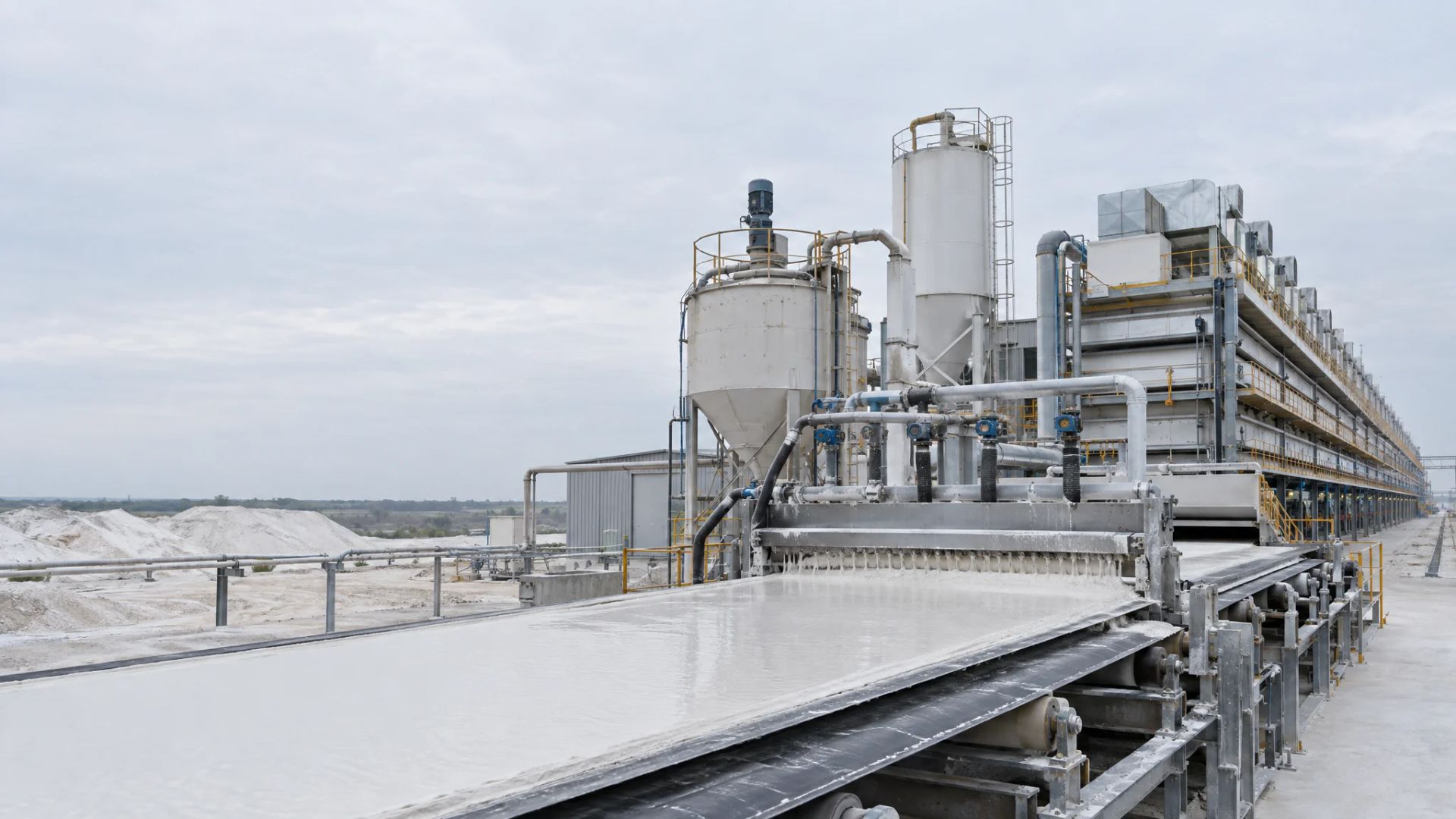
Gypsum wallboard line with calcination, forming and drying operations

Common problems

Problems that cost you before you notice

None of these shows up as a single alarm. They show up in the fuel bill, in dryer residence time, and in board that waits longer than it needed to.

  1. Stucco quality is confirmed after the stucco has been used

    Consistency, free water and combined water come back from periodic lab samples while the calciner runs continuously. The mixer then sizes its water setpoint around the widest stucco the line might produce.

    See: Stucco Calcination Consistency
  2. Slurry water is set for pourability, not dryer load

    More water keeps the slurry processable when stucco quality varies. That water becomes dryer energy and longer residence time before the board can leave the plant.

    See: Water-to-Stucco Ratio Optimization
  3. One dryer profile is run for the hardest product on the schedule

    Zone setpoints stay fixed while the evaporation load moves with water ratio, board thickness and line speed. Running hot enough for the worst case spends gas on margin, and over-drying still risks the paper bond.

    See: Board Dryer Zone Thermal Optimization

Use cases

Places worth a closer look

Each is a specific starting point — this calciner, this mixer, this dryer load — and a next conversation if it is worth your time.

Gypsum calcination and combustion systems where feed, temperature and residence time set stucco quality
Process

Stucco Calcination Consistency

Estimate stucco water demand, free and combined water from gypsum calciner and feed data so consistency is managed at the calciner, not only compensated at the mixer.

See the full use case
Wallboard slurry mixing and water systems where gauging water enters the production line
Process

Water-to-Stucco Ratio Optimization

Recommend a minimum safe water-to-stucco ratio for wallboard slurry from stucco, recipe and QC history so dryer gas load falls without trading away flowability or board quality.

See the full use case
Multi-zone industrial drying equipment with zone temperature, humidity and airflow control
Energy

Board Dryer Zone Thermal Optimization

Recommend multi-zone wallboard dryer temperature, humidity and airflow profiles for the board actually in the dryer, with paper bond risk as a hard constraint.

See the full use case

FAQ

Questions that come up in every first call

A practical look at what INSUS needs, where it fits and what your team can expect.

The work that fits starts from data a wallboard plant already produces: mixer water and stucco metering, admixture dosing, stucco laboratory results, dryer gas consumption, and board QC such as set time, weight, hardness, and paper bond. Closed-loop mixer dosing and automatic grading of every board are not promises we will make.

Usually not for calciner records, dryer zones, moisture checks, and maintenance. Most lines already have combustion controls, historians, forming instrumentation, and some reclaim handling. If a moisture gauge has been drifting or a dryer zone is unread, that comes before any model.

No. The person who knows this calciner, this slurry, and this dryer stays responsible. The aim is to stop the next shift running extra dryer heat from habit, and to flag a developing equipment issue before it stops the line.

No. It advises the operator or the process engineer. Existing combustion systems, PLCs, and any APC stay in charge of the loop. Safety interlocks are not touched.

No. Energy and board quality depend on feed, stucco quality, slurry water, equipment condition, and operating practice. We will not invent a savings percentage or a reject-rate target for your plant.

It is the share reported in DOE-funded gypsum drying analysis for wallboard manufacturing energy, not a measurement of your line. Your historian and utility meters are the numbers that matter.

Yes. The approach is built around the systems you already run. Integration is defined during the assessment. Statutory recipes, tickets, and emissions reporting remain yours.

Yes. One calciner train, one dryer section, or one reclaim loop is usually the practical start. Measure that, then decide whether to widen.

Contact

Talk to a gypsum expert

  • 30 minA focused conversation about the gypsum manufacturing problem you are trying to solve. No sales deck.
  • OutcomeA practical view of whether INSUS can help, what data would be needed and where it makes sense to start.
  • We will first understand your current process, what information you have and where the biggest gap is.
  • If the right answer is a sensor check, a slurry recipe update, a maintenance action or an existing system, that is what we will tell you.

Request a call

We reply within one working day, from a person, with a proposed time.