Today
The interval is set, the loss is estimated
- Intervals follow a schedule or a general OEM recommendation.
- Degradation is judged from raw readings that ambient conditions obscure.
- Recoverable fouling and irreversible ageing are not separated.

INSUS tracks axial compressor fouling on an ambient-corrected baseline, separates recoverable loss from irreversible ageing and prices it in lost MW and fuel. Performance engineers keep the wash decision.
01
Output and heat rate degrade together as the compressor fouls.
02
Ambient-corrected, because raw readings hide the trend.
03
Advisory only. Your team schedules the wash.
The problem
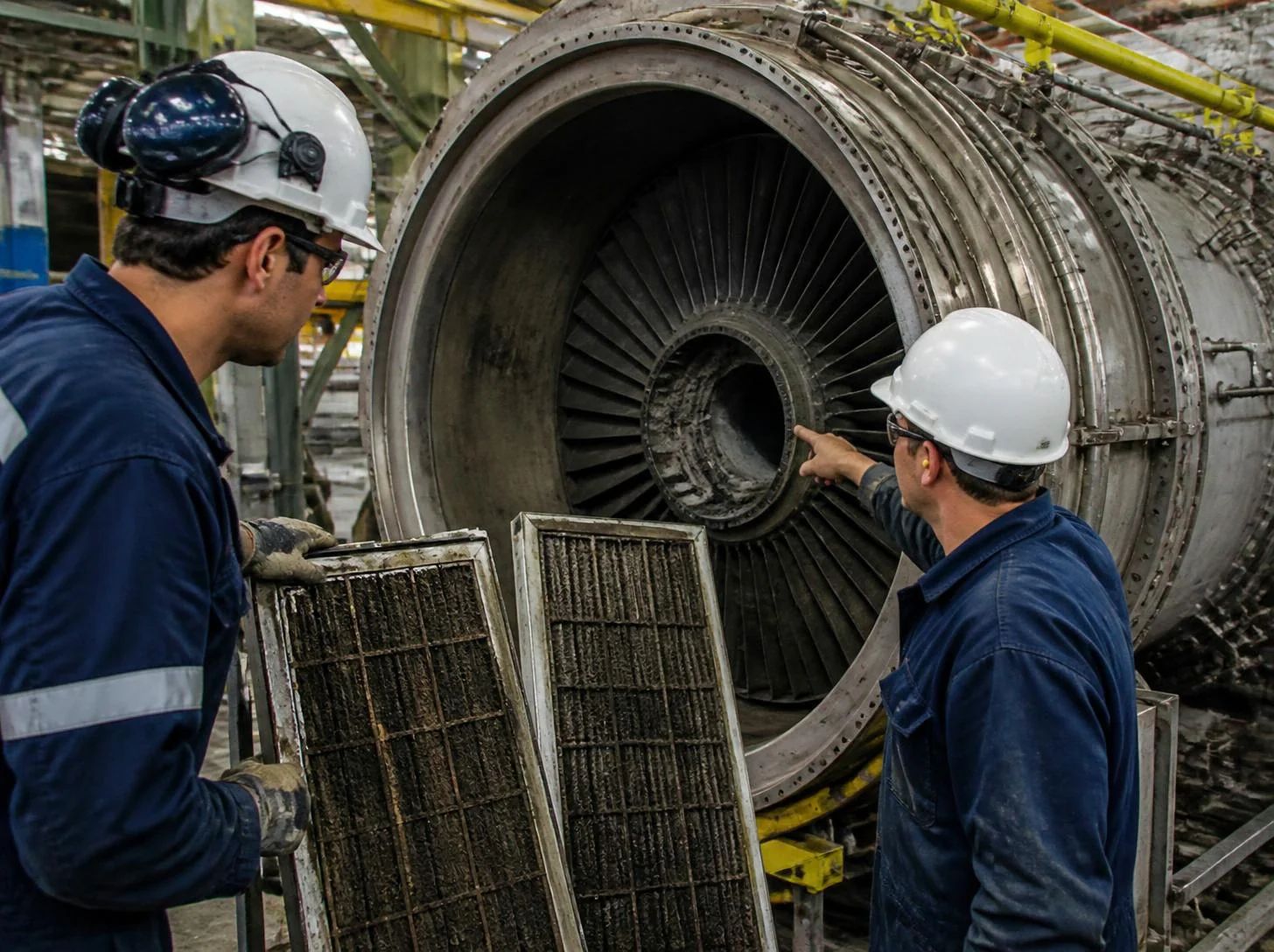
Raw output moves with ambient temperature, humidity and pressure more than with fouling, so gradual loss is hard to see and harder to justify an outage over. Fouling reduces mass flow and pressure ratio, cutting output and raising heat rate. Online washing slows fouling; offline washing recovers what online cannot. Calendar intervals often mean washing too early or too late.
The shift
Wash procedures stay the same. What changes is when the outage is justified, using corrected loss and cost for this machine.
Today
With INSUS
How it works
This fits OptiStudio as performance decision support beside existing turbine and historian systems. Access is read-only. Engineers decide when to wash.
Connect
Connect read-only to compressor pressures and temperatures, inlet filter differential, ambient conditions, IGV position, fuel flow, output, exhaust temperature, operating hours and wash history.
Understand
Establish a clean performance baseline for this machine. Split deviation into fouling-driven degradation, irreversible ageing and measurement drift so washing is not asked to fix losses it cannot recover.
Predict
Project the degradation trajectory and estimate what an online wash and an offline crank wash would each return, based on this machine's own wash history.
Advise
Show where accumulating lost generation and extra fuel exceed wash and outage cost, using your dispatch value and fuel price. Engineers decide, because outage timing depends on dispatch obligations the model cannot see.
Verify
Compare predicted and realised recovery against each wash's pre-wash baseline. Falling recovery can flag irreversible degradation that washing will not reverse.

Getting started
For gas turbine and combined-cycle plants with performance and wash history. Delivered through OptiStudio as wash-timing decision support. Expert Services can help with data assessment and validation. Advisory and read-only. No new hardware.
Related for power
Compressor wash economics sits beside cycling damage and minimum emissions-compliant load on the same generating unit.
Compressor fouling is hard to see in raw output and wash intervals are often calendar-based. This use case tracks ambient-corrected degradation and advises when a wash is worth its outage cost.
At least two years of performance and ambient data, wash history with type and duration, and fuel and output records. No new sensors when standard turbine instrumentation already exists.
Possibly nothing, and discovery should establish that honestly. Where existing monitoring reports degradation but not wash economics against your dispatch value and outage cost, that gap is the use case.
No. Engineers decide when to wash. Access to the turbine control system and DCS is read-only. There is no closed-loop version.
Recovery varies widely by site and fouling severity. Each machine is modelled from its own wash history. Published recovery figures are not a typical expectation and are not INSUS results.
Through OptiStudio as performance decision support. Expert Services can support data assessment, integration and validation with your performance team.
Ambient correction quality and wash-record completeness bound the analysis. Recommendations are unit-specific. The system does not schedule outages or guarantee recovery.
Power · Gas turbine performance
A back-test on your own performance history will answer that, and show whether the wash before it was worth its outage.