Today
A commissioning figure held with margin
- Minimum load is fixed at commissioning and held with margin.
- Emissions behaviour at low load is known mainly from experience.
- Shutdown is chosen by default when prices fall.

INSUS predicts CO, NOx and steam-side behaviour at low load for today's ambient conditions, configuration and machine state, so riding through a low-price period can be priced against shutting down. Operations and compliance keep every load decision.
01
The floor is often set by the CO limit, not the machine.
02
Loads never run are flagged as extrapolation.
03
Advisory. Operations and compliance decide every move.
The problem
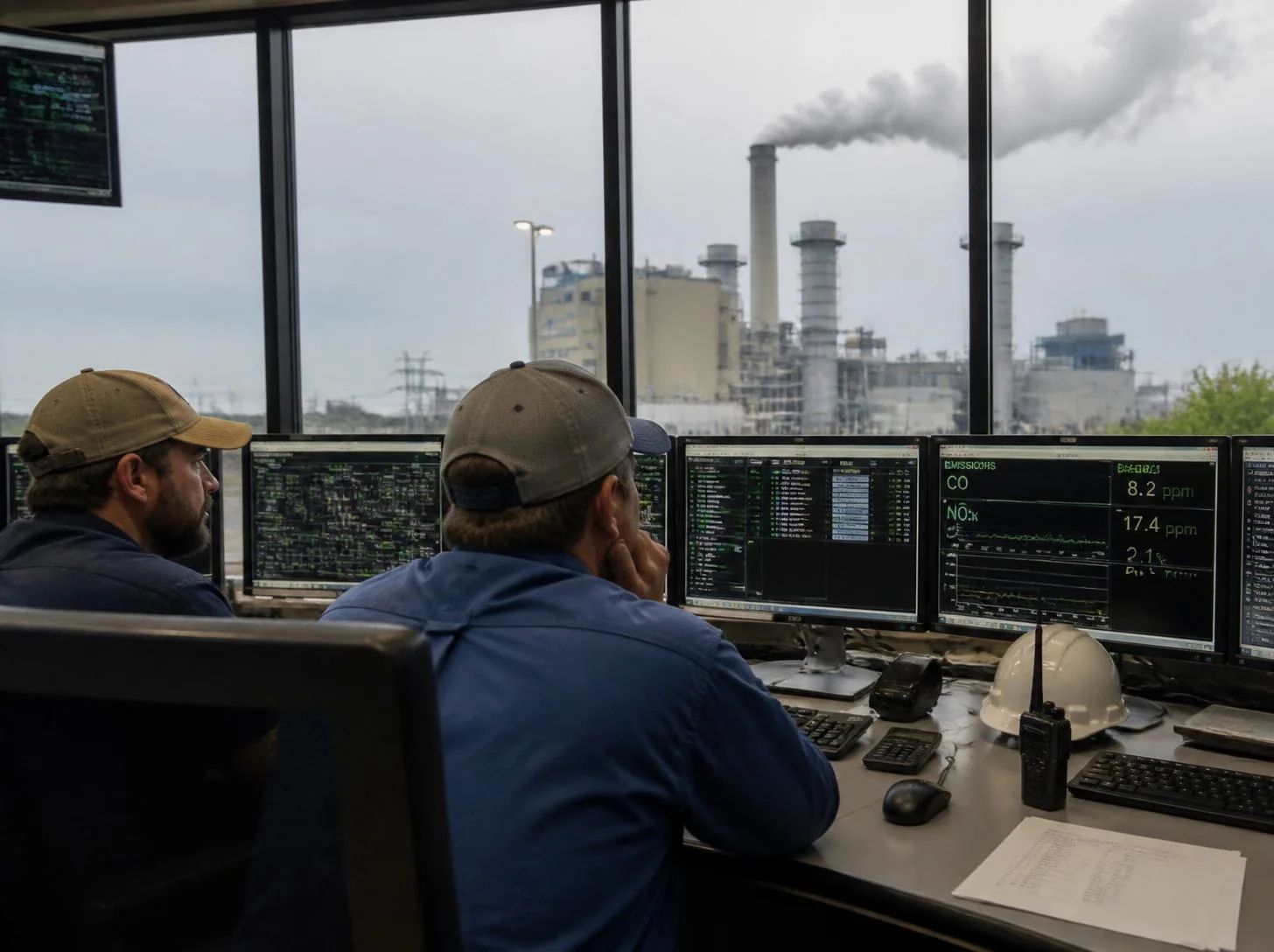
Turning down is often cheaper than shutting down, if the unit stays inside its permit. CO typically rises at part load as combustion temperature falls. Low load also stresses steam-side limits: SCR temperature, economiser steaming and circulation stability. Most plants hold a commissioning minimum with margin and shut down when prices fall, paying for a start that may not have been necessary.
The shift
The permit does not move. What can move is how confidently the plant knows where it sits relative to it.
Today
With INSUS
How it works
This fits OptiStudio as optimisation under hard compliance constraints beside existing CEMS and plant systems. Access is read-only. Operations and compliance decide every load move.
Connect
Connect read-only to CEMS CO and NOx, load and fuel flow, combustion mode, exhaust and HRSG temperatures, SCR conditions, drum levels, ambient conditions and permit limits with averaging periods.
Understand
Learn how CO and NOx have behaved across the load range on this machine, under different ambient conditions and states of degradation, and mark where that experience ends.
Predict
Predict CO and NOx at candidate loads with uncertainty, plus steam-side indicators for SCR temperature, economiser steaming and circulation. Flag loads outside the observed range as extrapolation.
Advise
Recommend the lowest load that holds emissions and steam-side constraints with defined margin, and compare holding that load against shutting down and restarting using your start cost.
Verify
Compare every low-load period with what was predicted. An unexplained permit excursion stops the recommendation until it is resolved.

Getting started
For combined-cycle operations and environmental compliance teams. Delivered through OptiStudio as low-load decision support. Expert Services can help with data assessment and validation. Advisory and read-only. No new hardware.
Related for power
Minimum emissions-compliant load sits beside cycling damage and compressor wash economics on the same generating unit.
Minimum load is often an inherited commissioning figure held with margin. This use case predicts emissions and steam-side behaviour at low load so the real compliant floor can be reviewed for today's conditions.
At least two years of load, CEMS, HRSG and ambient data, permit limits and averaging periods, and start records. No new sensors when CEMS and HRSG instrumentation already exist.
No. The permit holder remains responsible for compliance. The system does not interpret or negotiate permit terms.
The model flags extrapolation. A confident recommendation about loads the unit has never run is not offered as routine advice.
No. Operations and environmental compliance decide every load move. Access is read-only. Closed-loop control against a permit limit is out of scope.
Through OptiStudio as low-load decision support. Expert Services can support data assessment, integration and validation with your operations and compliance teams.
Confidence is bounded by the load range already operated. OEM combustor upgrades may lower the achievable floor more than software alone. The system does not schedule load or certify compliance.
Power · Flexible operation
Start with the emissions and constraint map for the load range you have already operated, including an honest account of how far below it your data can support going.